
A load-bearing wall transmits the loads from the roof, floors, and sometimes other walls down to the foundations. Modifying this load path without recalculating it exposes the structure to deformations, cracks, or partial collapse. Before any cutting, the work begins with a structural analysis that determines the nature of the loads, their intensity, and the type of reinforcement needed.
Load Path and Structural Study: The Technical Prerequisite
The load path is the calculation that quantifies all the forces that pass through the targeted wall: the self-weight of the floors, partitions above, furniture, occupancy, and roofing. This calculation determines the sizing of the replacement beam (IPN, IPE, or HEA) and the section of the lateral supports.
A structural engineering firm performs this calculation and produces a technical note. This document specifies the section and profile of the beam, the minimum support length on the remaining masonry, and, if necessary, the need to reinforce the foundations under the support points.
The temptation to rely on a contractor’s estimate without this note is common. Several renovation firms in Paris report that property managers now refuse simple estimates without a detailed structural report, which extends validation times by several weeks.
Ordering the study in advance, even before consulting masonry companies, helps save time on the overall schedule. Successfully opening a load-bearing wall primarily relies on this step.
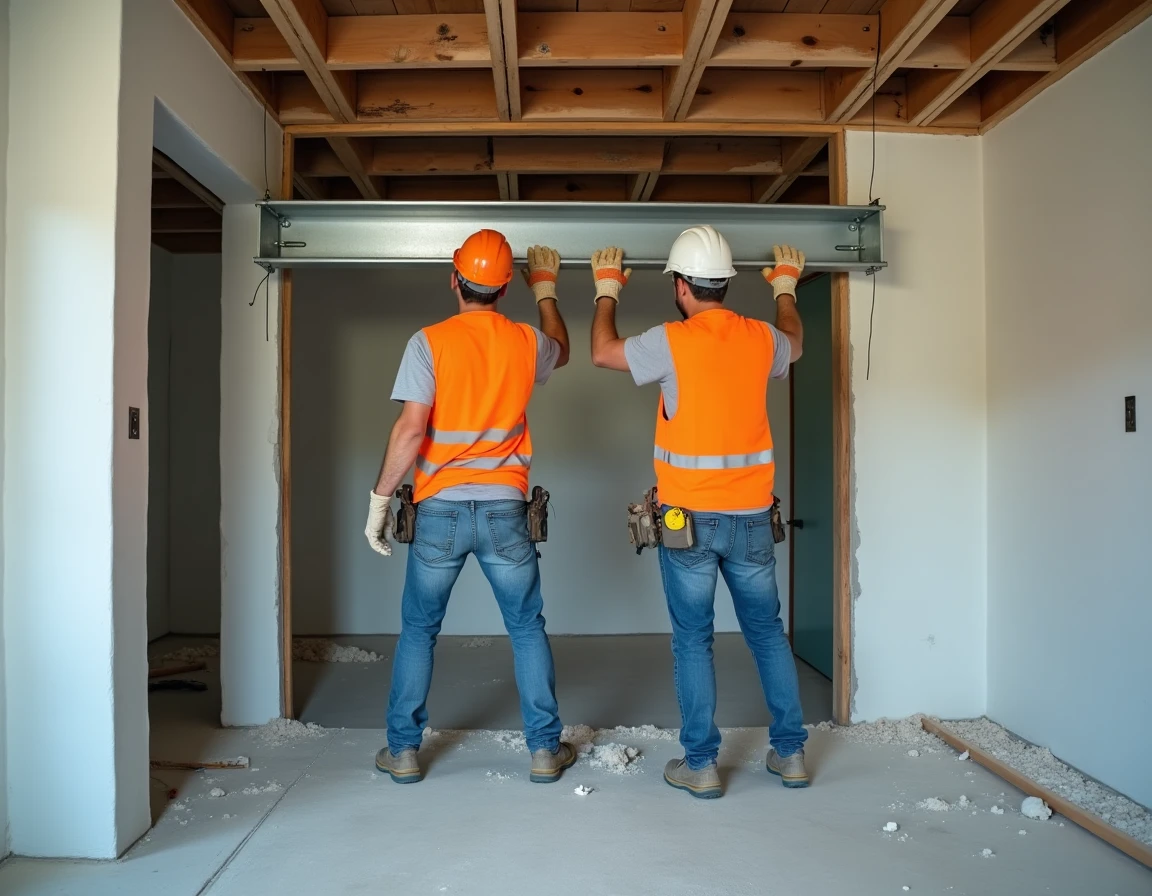
Undersized Beam and Insufficient Supports: The Two Critical Structural Errors
Requests for large openings (open kitchen to a through living room, complete removal of a load-bearing partition over several meters) have increased. Two recurring errors appear in feedback from engineering firms and metalworkers.
Inappropriate Beam Profile for the Span
A beam that is too light for the actual span and permanent or variable loads will sag under the load. This sagging generates cracks in adjacent partitions, deforms door frames, and can compromise the upper floor. The profile must be calculated for the actual span, not estimated from a generic table.
Specifically, an IPE or HEA profile is chosen by cross-referencing the clear span of the opening, the total load from the load path calculation, and the allowable deflection defined by calculation rules. A profile selected “by eye” by an experienced craftsman may be suitable for small openings, but becomes a real risk beyond two to three meters of span.
Insufficient Support Length
The support of the beam on the remaining masonry must be sufficient to distribute the loads without crushing the wall. A support that is too short concentrates pressure on a reduced surface, causing local crushing of the masonry, especially on stone or old brick walls. The calculation note from the engineering firm sets this minimum length, and the mason must adhere to it down to the centimeter.
Low-Vibration Cutting Techniques to Limit Collateral Damage
The method of cutting the wall directly influences the condition of the adjacent floors, partitions, and coverings. Techniques have significantly evolved towards low-vibration impact processes.
- The diamond blade cutting is preferred for concrete or stone walls. It limits shocks and chipping compared to a jackhammer, which transmits vibrations throughout the structure.
- The wall saw cutting allows for clean openings with regular edges, facilitating the installation of the beam and reducing the transmission of vibrations to neighboring elements.
- Temporary shoring of the upper floor remains mandatory regardless of the cutting method. Props are placed on either side of the wall before any intervention, to temporarily bear the loads during the installation of the lintel or beam.
These low-vibration techniques also reduce neighborhood disputes in condominiums. In older buildings, a jackhammer can cause cracks in neighboring properties, which are then documented by a bailiff. The additional cost of diamond cutting is well justified against the risk of repairs required after the work.

Condominium and Permits: Often Underestimated Obligations
In a condominium, a load-bearing wall is part of the common areas, even if it is located inside a private apartment. Its opening requires a vote in the general assembly of co-owners, by the majority defined by the condominium regulations.
The file submitted to the property manager must include the calculation note from the engineering firm, the plans before and after the work, and often a ten-year insurance certificate from the company that will carry out the work. Without a favorable vote from the general assembly, the work is illegal, even if the structural study concludes that it is feasible. A co-owner who disregards this is subject to a requirement to restore the property at their own expense.
In a single-family home, the main constraint remains compliance with urban planning regulations if the opening modifies the exterior appearance (for example, creating a bay window). A prior declaration of work may be required according to the local urban planning plan.
Finishes and Restoration After Opening a Load-Bearing Wall
Once the beam is installed and sealed, the finishes affect both the aesthetics and durability of the work. The cladding of the metal beam (drywall casing, plaster, wood) protects the profile from corrosion in humid areas and conceals the raw steel.
The restoration of the floors at the level of the old wall often leaves an uncovered strip. Anticipating this connection from the design phase avoids having to redo the entire floor of the room. For old wooden floors, the connection of boards at the location of the old wall requires specific expertise that not all installers possess.
Cracking due to shrinkage often appears in the weeks following the work, at the junctions between the old wall and the new finishes. They do not necessarily indicate a structural problem, but should be monitored. A crack that gradually widens justifies a check by the engineering firm that performed the initial calculation.