
The recommendation of seven to nine hours of sleep per night for an adult is widely circulated. It primarily comes from the National Sleep Foundation, echoed by most health authorities. This framework remains a statistical average, not an individual prescription. Understanding what duration of sleep truly corresponds to effective rest requires going beyond a simple count of hours.
Chronodeficit and Bedtime: The Angle That Duration Alone Does Not Cover
Two people can each sleep seven and a half hours, with very different results on their daytime performance. The variable that explains this gap has a recent name: chronodeficit. It does not refer to a lack of hours, but a misalignment between when the body demands sleep and when the person actually goes to bed.
Research published in Current Biology in 2022 by Roenneberg and his colleagues shows that nights centered before 1 a.m. are associated with better metabolism and lower depressive risk than nights of the same duration but much later. Sleeping from 2 a.m. to 9:30 a.m. does not produce the same biological effect as sleeping from 11 p.m. to 6:30 a.m.
This misalignment, sometimes called “social jetlag,” particularly affects people whose natural chronotype (night owl or early bird) conflicts with their work constraints. The timing of sleep matters as much as its duration. To better determine what duration of sleep for an adult is truly appropriate, this timing parameter must be integrated.
Sleep Quality in Adults: When Seven Hours Is Not Enough
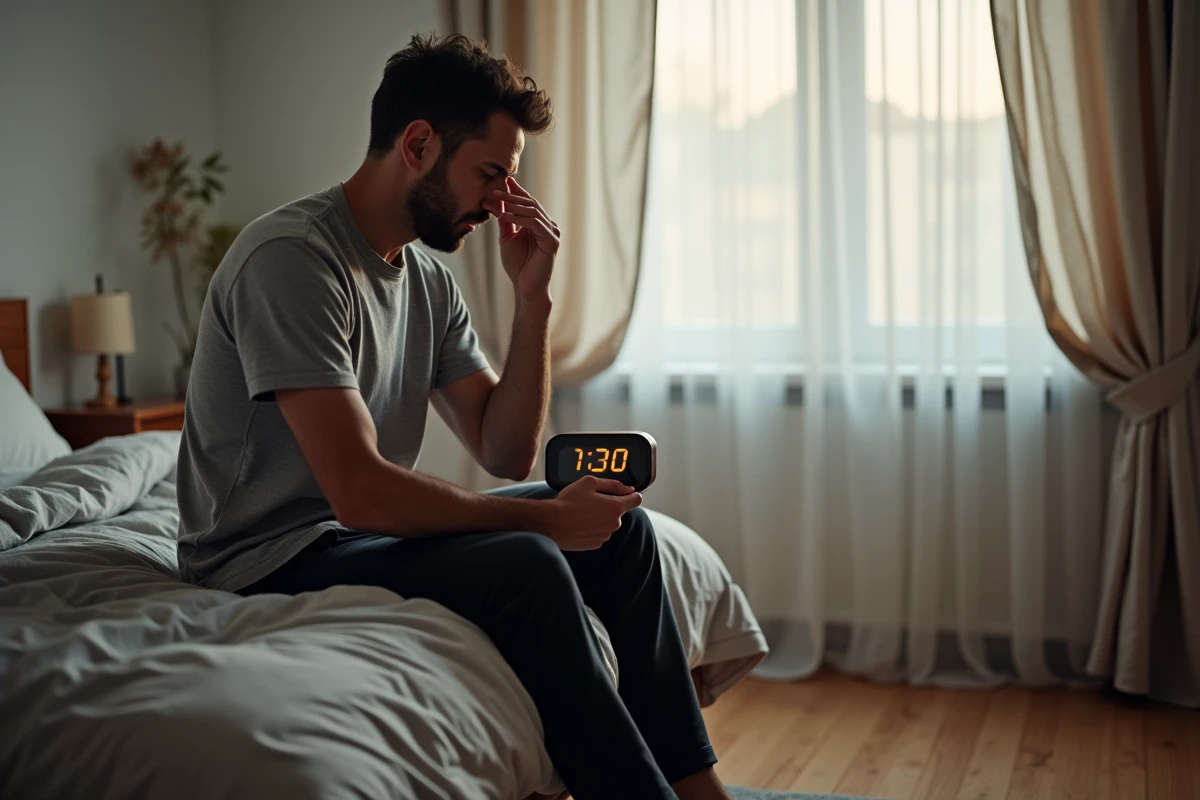
Since the post-Covid reports from the WHO and ECDC published between 2022 and 2023, sleep quality is considered a clinical marker to monitor alongside duration. Adults who sleep between seven and eight hours but report fragmented sleep (repeated nighttime awakenings, feeling of unrefreshing sleep) have fatigue profiles comparable to those who sleep less than six hours.
This distinction between duration and quality changes how one evaluates their own rest. Three criteria help identify a quality issue rather than a quantity issue:
- Falling asleep that regularly takes more than thirty minutes despite feeling tired, which may signal a circadian rhythm shift or hyperactivation of the nervous system
- Frequent nighttime awakenings (two or more per night) followed by difficulty falling back asleep, often linked to anxiety and depressive disorders that have increased since the post-Covid period
- A persistent feeling of fatigue upon waking despite time spent in bed conforming to recommendations, sometimes described as “empty” sleep
The available data do not yet allow for setting a universal quality threshold. However, the combination of correct duration and fragmented sleep warrants a consultation rather than a simple schedule adjustment.
Sleep Regularity and Cardiovascular Health: The Recent Criterion
In 2022, the American Heart Association included sleep regularity in its “Life’s Essential 8” criteria for cardiovascular health. It is no longer just “Are you sleeping enough?” but “Are you sleeping at the same times?”.
Real-life actigraphy data show that significant variability in bedtimes and wake times (a difference of more than 90 minutes between weekdays and weekends) is associated with poorer daytime performance, even with equal total sleep duration. In other words, catching up on the weekend does not compensate for a deficit accumulated during the week.
What Regularity Changes in Practice
The human body operates on a circadian rhythm of about 24 hours, driven by the internal clock. Each schedule shift forces a resynchronization that consumes energy and disrupts melatonin secretion. A stable bedtime enhances the quality of each sleep cycle.
The REM sleep phase, associated with memory consolidation and emotional regulation, is particularly sensitive to these variations. An adult who regularly shifts their bedtime by more than an hour reduces the proportion of REM sleep in their night, even if the total duration remains within the recommended range.

Adjusting Sleep Duration: The Limits of General Recommendations
The range of seven to nine hours for an adult hides a more nuanced reality. Some adults function optimally with six and a half hours, while others need a full nine hours. Age, physical activity level, health status, and natural chronotype modify individual needs.
A reliable indicator remains the ability to wake up without an alarm and maintain stable alertness during the day. If you need caffeine to last until noon or if you experience marked drowsiness in the early afternoon (beyond the normal slight physiological dip), your sleep is likely insufficient in duration or quality.
Chronic sleep disorders (insomnia, sleep apnea, restless legs syndrome) require specific diagnosis. Simply adjusting the time spent in bed does not resolve a structural problem. Field reports vary on this point: some general practitioners recommend first sleep hygiene adjustments, while sleep specialists prefer a more in-depth exploration at the first signs of unrefreshing sleep.
Three parameters deserve to be monitored alongside duration:
- The regularity of bedtimes and wake times, including on weekends, with a limited maximum gap
- The quality felt upon waking, noted over several weeks in a sleep diary
- The time taken to fall asleep, which gives an indication of the alignment between the chosen bedtime and the actual circadian rhythm
Sleeping at the right times, regularly and without fragmentation provides a greater benefit than simply accumulating minutes. Duration recommendations remain a useful starting point, not a finish line.